Why Rivers Cross Borders Before Their Water Does
Why rivers cross borders before their water does: see how upstream decisions affect downstream needs and how neighbors can coordinate around a shared river.
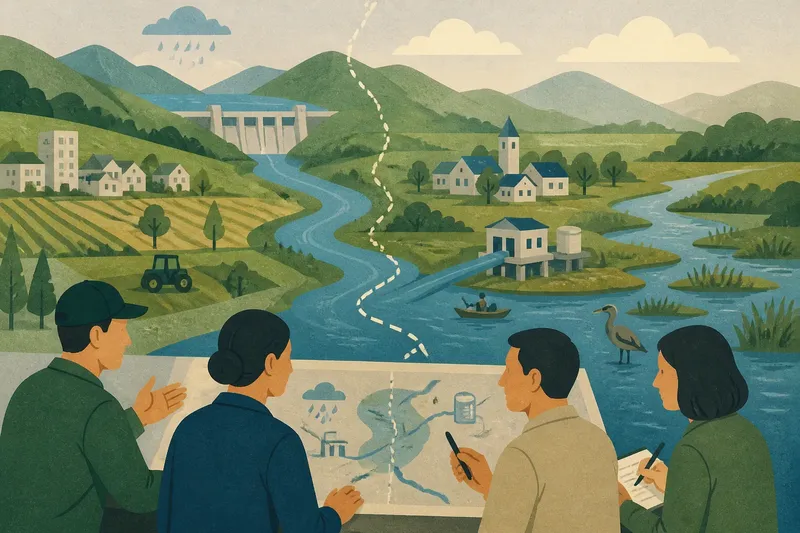
Why rivers cross borders before their water does becomes clear when an upstream decision changes the flow, timing, or condition of water downstream communities rely on. The connection begins in the watershed, where rain, land use, and river management link places on both sides of a political boundary.
How does a shared river connect people?
Imagine the fictional Luma River. It rises in the hills of Arven, runs past farms and a growing town, then enters neighboring Belor before reaching a wetland. The names and events are invented. A watershed is the area where rain and snow drain toward the same river system.
People in Arven draw water for homes and crops. Belor’s riverside towns rely on the downstream flow, while fishers and farmers depend on the wetland. Their needs differ, but the same river links them. Water taken or held upstream can affect how much arrives downstream and when.
A national border does not divide the watershed. Rain falling in one country may flow into a river in another. Sediment, nutrients, and pollutants can also travel with the current. Reservoir operations, drainage projects, and dry weather can all affect river conditions, though the effects depend on the basin and circumstances.
What can change when an upstream community stores water?
Say a dry spell begins in the fictional Luma basin. Arven’s irrigation district wants to store more water so growers can keep young crops alive. The town also needs water for households. Belor expects enough flow for its intakes and for the wetland’s connection to the river.
Holding water can change when it moves downstream. A later release may arrive after a community expected it, while a sudden release may create a brief surge instead of a steadier flow. The result depends on rainfall, reservoir conditions, river features, and operating decisions. Downstream residents might notice a change at an intake, in fishing conditions, or in water reaching side channels.
This creates a difficult balance. Upstream communities may have direct control over infrastructure or land-use decisions, while downstream communities can experience their effects without taking part in them. Neither position captures the whole picture: downstream needs matter, and upstream residents also have legitimate needs.
How can neighboring countries coordinate?
Imagine Arven and Belor form a fictional joint river group with local water officials, farmers, town representatives, and wetland managers. Rather than promising that every need can be met, the group agrees to share information, explain uncertainty, and discuss decisions before they affect the river.
Check whether both sides can access current rainfall observations; if they can, use them to discuss changing conditions, and if they cannot, agree on a shared way to report what is known.
Check whether river-flow readings come from locations relevant to local intakes; if they do, compare them across the border, and if they do not, identify which additional locations would make the reports useful.
Check whether reservoir-level information is available to both sides; if it is, include it in planning discussions, and if it is not, ask what information can be shared and who can provide it.
Check whether planned maintenance or unusual releases have a clear notice route; if they do, use it to alert affected operators, and if they do not, name a contact person and an alternate route.
Check whether reports explain uncertainty and local implications; if they do, use them to prepare, and if they do not, ask for plain-language explanations before treating them as a basis for decisions.
Check whether both sides review what happened after a release or dry spell; if they do, compare observations and adjust the process, and if they do not, schedule a joint review while details are still clear.
These checks do not settle every competing need. They make tradeoffs easier to discuss. A proposed release, for example, can be considered alongside crop demand, household use, and the wetland’s seasonal needs instead of being treated as a purely technical choice.
Plain language matters. A flow report helps only if local officials and affected communities can understand what it may mean for an intake or field. Sharing data without explaining its limits can create false confidence; describing uncertainty gives people room to adjust.
What can cooperation change, and what remains difficult?
Imagine Arven plans a reservoir release and notifies Belor through the joint group. Belor’s intake operators can discuss preparations, and both sides can observe how the river responds. If the water arrives later or in a different condition than expected, they have a channel for comparing observations and adapting their next decisions.
Coordination cannot create water during a dry spell or resolve every disagreement. It can make decisions more visible and reduce avoidable surprises. It may also help communities consider whether a change reflects an upstream action, low rainfall, or another condition in the basin.
Formal agreements may set shared principles, data practices, or ways to raise disputes. Local cooperation matters alongside them: people managing an intake, farm canal, or wetland may need information that national offices do not provide directly. The appropriate arrangements depend on the river and the rules that apply; water authorities or qualified local professionals can clarify local requirements.
What do readers ask about shared rivers?
Does an upstream country control all the water?
It may control some infrastructure and land-use decisions near the river’s source, but a river belongs to a connected basin rather than one stretch of channel. Downstream communities have needs that may be affected by those choices.
Why does timing matter if water keeps flowing?
Homes, farms, intakes, and wetlands need water under particular conditions and at particular times. A later flow or sudden surge may create practical difficulties even when water continues downstream.
What information helps neighboring communities coordinate?
Observations about rainfall, river levels, reservoir conditions, planned releases, and water quality can help people discuss what is happening. Clear notice and a reliable contact route make those observations more useful.
Can a river agreement prevent every dispute?
No agreement removes scarcity or ensures that every party will agree. A clear process can help communities raise concerns, explain decisions, and adapt when conditions change.
How does the Luma River illustrate cross-border connections?
The fictional Luma shows why rivers cross borders before their water does: a watershed connects decisions and consequences before the current reaches a boundary. If Arven’s storage choices change the flow Belor receives, those choices affect more than Arven. Belor’s needs are part of the basin’s shared reality, not an afterthought at the river’s end.
When you hear about a shared river, ask where its water comes from, who can change its timing or condition, who depends on it downstream, and how those people share information. Those questions help reveal where cooperation may be useful before the water reaches the next country.