Cable, Tower or Satellite: Three Paths Messages Take
Cable, tower or satellite message paths show how a phone’s local connection joins wider networks, helping you understand where communications travel and why routes differ.
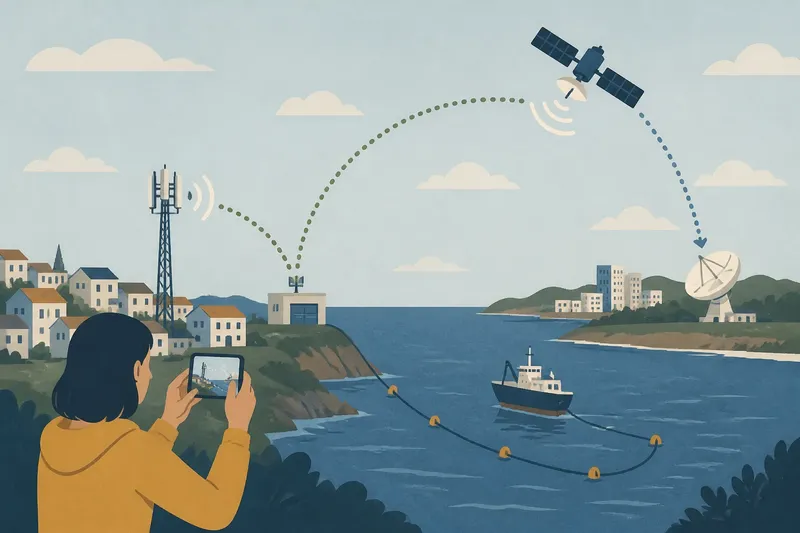
Cable, tower or satellite message paths depend on where a message starts, where it needs to go and which connections are available. A video call from a city apartment might begin over a local wireless link, travel through terrestrial networks and cross an undersea cable before reaching someone overseas. These links are not competing versions of one system; they can connect as parts of the same journey.
A message is broken into small pieces, sent through connected equipment and reassembled at its destination. Along the way, it can switch from one kind of link to another. Think of transfers on a journey, not a single road running from sender to receiver.
What does each path connect?
Undersea cables link land-based networks across oceans and seas. They carry light through glass fibers laid along the seabed and connect to landing stations on shore. From there, land cables carry traffic toward homes, businesses, data centers and other networks.
Terrestrial towers provide radio links between devices and nearby network equipment. A cell phone sends a signal to an antenna on a tower or rooftop site. That site usually connects onward through fiber-optic cable or a microwave radio link. Towers are part of a larger system, not isolated transmitters reaching directly to every other phone.
Satellites carry signals between ground equipment and spacecraft in orbit. A signal travels from a ground station or user terminal up to a satellite, then back down to another receiving point. This can help connect places where building terrestrial links is difficult or provide a link across a broad area.
Each path has its own geography. Cables follow routes between shores and through land corridors. Towers are placed to serve particular areas and terrain. Satellites cover regions from above, but still rely on ground equipment and connections to the rest of the network.
How can one message use all three?
Imagine a traveler in a coastal town sending a photo overseas. In this invented situation, the phone sends the photo to a nearby cell tower. The tower passes the data into a land network, which routes it toward a cable landing station. An undersea cable carries it across the ocean, and another terrestrial network delivers it toward the recipient’s local connection. The visible result is a photo arriving at the recipient’s device; the sender does not need to know each transfer for the route to work.
Here is a second invented situation. A remote community has a local cell tower, but no direct submarine cable landing. A provider links its network to a satellite-connected ground terminal. A resident sends a message from a phone to the tower, and the provider’s satellite link carries the traffic to a wider network. The observable result is that the phone’s local radio connection and the satellite link serve different parts of the same journey.
The route can change from wireless to wired and back again as a message moves through equipment owned or operated by different organizations. The satellite does not have to connect directly to the phone; it may instead link the community’s network to a wider one.
Why do the routes feel different?
Distance and delay are related, but the physical route matters too. A cable sends signals along its route. A satellite connection sends signals up to orbit and back down, so its path can be longer than a direct terrestrial one. That difference can be noticeable in conversations that rely on quick turn-taking, though the service and the rest of the route also affect the experience.
Towers often make a phone connection feel local because the first radio hop is nearby. A call to someone far away still needs a route beyond that tower. Cables can carry traffic between network hubs, while satellite links can connect places without a nearby cable route. These are tendencies, not a universal ranking: network design, congestion, weather, equipment and available alternatives all matter.
The physical risks differ, too. A seabed cable can be damaged by activities such as anchoring or fishing gear. A tower’s service can be affected by local power or equipment problems. Satellite links depend on working ground terminals and clear communication paths to the spacecraft. Networks may use alternate routes and repair plans where feasible, but no path is immune to disruption.
What do coverage and capacity tell you?
Coverage describes where a service can reach; capacity describes how much traffic a connection can handle at a given time. A satellite footprint may span a large region, but that does not mean every user has identical service or available capacity. Terrain, terminal equipment and network design shape what people can access.
A tower’s coverage depends on placement, surrounding buildings, hills and the frequencies used. A phone may show a weak signal in a basement even if a tower is nearby, because walls and terrain interfere with the radio path. Cable capacity depends on installed equipment and how operators configure the link, not simply on the cable’s existence.
If you are trying to understand a home internet service, check the provider’s description for its local connection type: fiber, cable, fixed wireless or satellite. That tells you how the service may reach the home, though it may not reveal every upstream link. It is not worth trying to infer a message’s complete route from a map of nearby towers; provider networks and routing decisions add connections that the map may not show.
Which questions help identify cable, tower or satellite paths?
Does a phone call travel only through towers?
No. A tower commonly connects a phone to the local network, but the call can then travel through fiber, microwave links, other carrier networks or, in some cases, satellite connections. The full route depends on where callers are and how their providers interconnect.
Do undersea cables connect directly to homes?
Usually not. They land at coastal stations and feed into terrestrial networks, which carry traffic onward to homes and devices. The cable is one long-distance segment in a broader chain.
Can a satellite replace a tower?
Satellite service can connect places where terrestrial networks are limited, but it does not duplicate every role of a local tower. A phone still needs compatible equipment and service arrangements, and a satellite link may connect a community network rather than each handset directly.
Why can a message take different routes at different times?
Network operators may route traffic around congestion, maintenance or an interruption. A message can therefore use a different sequence of cables, towers and other links even if the sender and recipient stay in the same places.
What can you check before drawing a conclusion?
- Check the provider’s service description for the local access type. If it names fiber, cable or fixed wireless, treat that as the likely connection to the home; if it names satellite, expect a space link, and ask the provider if the description is unclear.
- Check a coverage map for the location you care about. If the map marks service there, treat it as an indication rather than a view of every indoor signal; if it does not, ask about another connection option.
- Check whether a phone is connected to a nearby cell site, if your carrier provides that information. If it is, that identifies a likely first radio link, not the full route; if it is not, use the carrier’s coverage tools rather than assuming the call cannot connect.
- Check whether a route description names a cable landing station or terrestrial network. If it does, use that as evidence of a wired segment; if it does not, do not assume an undersea cable is absent, since public maps may not show every connection.
- Check what the provider says about its satellite equipment and ground terminal. If a terminal is part of the service, expect it to connect the local network to a satellite link; if the provider describes a different setup, ask how its service reaches the wider network.
- Check whether the question is about coverage, capacity or the full message route. If it is about coverage, consult the provider’s map; if it is about capacity, ask the provider about service conditions; if it is about the route, seek a network explanation instead of treating a coverage map as a route map.
These checks help separate what is visible from what is only a likely connection. A nearby tower can explain how a phone reaches a local network, but it cannot reveal every cable or provider link a message uses afterward.
What does a route map leave out?
A tower map cannot show the full journey of a message, and a cable map does not show every connection between a device and an overseas server. Provider networks, traffic conditions and the service being used all influence the route. It is more useful to identify the likely local access method, then recognize that long-distance traffic may switch paths several times.
Cable, tower or satellite names a kind of link, not a complete journey. A tower can carry a message off a phone, a cable can carry it between continents and a satellite can bridge a remote gap. The next useful question is often who operates the connection beyond the local link, because that is where one network hands traffic to another.