From Port to Shop: The Stops Along a Product's Route
Follow a product route from producer to shop and see how each handoff changes its location, responsibility, and readiness for the next buyer.
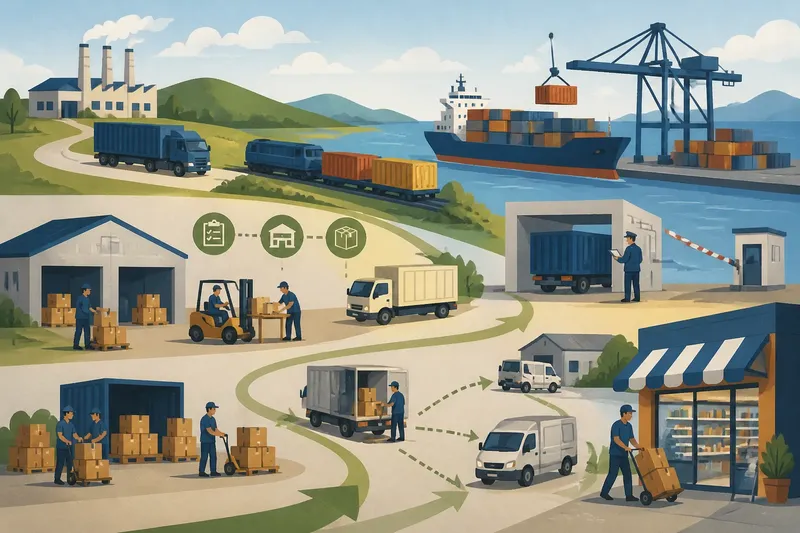
A product’s route from port to shop is a chain of handoffs, not one long trip. A shipment may leave a factory in a truck, join other freight at a terminal, cross a border by ship, and split into smaller deliveries before reaching a store. Each change of place can also change who is responsible for the goods and what must happen before they move on.
That distinction helps make trade easier to read. “In transit” describes movement, but not every stage behind it. A carton can be waiting for paperwork, being sorted in a warehouse, or traveling between distribution centers. To understand how an item gets to a buyer, follow both its physical route and the transfers of custody that connect it.
What does a product route include?
A route includes the places where goods are made, grouped, checked, transported, stored, and handed to the next party. It can also include a stop where an item is repacked or divided into smaller orders. Some products pass through only a few of these stages; others take a more involved path because of distance, handling needs, or the way a seller organizes its stock.
It is useful to distinguish a leg from a handoff. A leg is a stretch of movement, such as a truck trip from a factory to a rail terminal. A handoff is a transfer of responsibility, such as a carrier accepting a sealed container from a shipper. They may happen at the same place, but they are not the same event.
A route can cross several modes of transport without every mode touching the product directly. A shipping container may be moved from truck to ship while the cartons inside remain sealed. Later, a warehouse worker may open the container, count the cartons, and assign them to separate store orders. The container changes transport; the cartons change custody and destination.
Which route pattern fits the product?
Three broad patterns help explain why two products can follow different paths even when both travel internationally. They are not rigid templates. A company may combine them, and a shipment’s route can change when capacity, demand, or handling needs change.
Does a direct route suit a large, steady order?
A direct route moves goods from a producer or its shipping point toward a buyer with relatively few intermediate storage stops. It can suit a retailer ordering a full load of one product, or an industrial buyer receiving materials for a known production schedule. Fewer storage transfers may make the route easier to trace, while a large order requires the buyer to have space and a plan for receiving it.
“Direct” does not necessarily mean one vehicle or one uninterrupted journey. A container may travel by truck to a port, ship across an ocean, and truck again to the buyer. The useful distinction is that the goods do not need to pass through several inventory hubs for sorting into many different orders.
When does a hub-and-spoke route make sense?
A hub-and-spoke route brings freight to a central facility, then sends it outward to different destinations. A distribution center can receive mixed loads, store products, and assemble orders for stores in its service area. This pattern suits sellers that need to supply many locations from shared inventory, rather than send a separate international shipment to every shop.
The hub adds a handoff and a sorting task. It can also make later deliveries more flexible: a retailer can draw from stock already near its customers instead of waiting for a new shipment from the producer. The trade-off is that the route depends on the hub’s receiving, storage, and dispatch processes as well as the long-distance carrier.
Who benefits from a consolidated route?
Consolidation groups smaller shipments so they can travel together for part of the journey. It can suit a small importer whose order would not fill a container, or several businesses sending freight along a compatible route. At a consolidation facility, goods are grouped; near their destination, they may be separated again for delivery.
Sharing transport capacity does not mean the businesses share ownership of one another’s goods. Each order still needs to be identified and directed to its intended receiver. Consolidation can add waiting and sorting stages, so a buyer should consider the whole route rather than assume that a shared load follows the same schedule as a full shipment.
How does a handoff change the shipment?
Every handoff creates a point where information must travel with the goods. The receiver needs to know what has arrived, where it should go, and who is authorized to accept it. Documents and digital records can identify the cargo, link it to an order, and record that a carrier or facility has taken responsibility.
The details vary by product and route, but common records include a purchase order, a packing list, transport documents, and customs information. These records serve different purposes. A packing list describes the shipment’s contents; a transport document relates to its carriage; customs information supports the required border process. One record does not automatically answer every question another party needs to resolve.
At a port, goods may wait for a vessel, be transferred between carriers, or be selected for a border check. The port is a junction, not simply a doorway between countries. Once the shipment clears the relevant processes and leaves the terminal, another carrier may take over. The next destination could be a distribution center, a customs-controlled warehouse, or a buyer’s own receiving site.
Storage is another distinct stage. A warehouse may hold goods until a retailer needs them, combine items into store orders, or keep them available while demand is uncertain. That pause can be part of the planned route rather than a sign that the shipment has gone astray. If goods need particular conditions, the receiving party must also know what handling the product and its packaging require.
Where can a route slow down?
Delay can occur at any point where the next handoff depends on a missing document, unavailable transport, limited receiving capacity, or a mismatch between the shipment and its records. A container may reach a terminal before the paperwork is ready. A warehouse may receive the freight but be unable to match a carton to the expected order. A store may have the goods nearby but lack a scheduled delivery slot.
These situations show why a tracking page offers only a partial account. A scan usually marks an event that a carrier or facility has recorded. It may confirm that a parcel was accepted or that a container left a terminal, but it does not describe every activity between scans. The physical goods and the information about them travel together only when each party records and passes on the details the next party needs.
Imagine a small home-goods shop ordering a set of ceramic mugs from a producer overseas. The producer packs the order, a local truck carries it to a port, and a ship takes the container to a destination port. A forwarder arranges the transport and border documents; a distribution center then sorts the cartons with other shop orders. If one carton’s label does not match the receiving record, the shop may see the rest of its order arrive while that carton waits for clarification. The visible result is a partial delivery, even though the goods traveled together for much of the route.
In an actual shipment, the right handling and paperwork depend on the product, carrier instructions, and local rules; a qualified customs or logistics professional can help with requirements that affect a particular transaction.
How can a buyer choose a route?
Start with the shape of the order, not with a preference for the fewest stops. A large, predictable order may suit a more direct path. A business supplying several shops may need a distribution hub. A smaller order may fit consolidation, especially when sharing transport capacity makes more sense than sending a dedicated load.
Then ask what the buyer needs to control. A business with limited storage may prefer frequent replenishment through a nearby distribution center. One with a fixed production schedule may care more about a clear arrival window and coordinated receiving. A fragile, temperature-sensitive, or otherwise specially handled product calls for a route that can support its handling needs at every transfer, not only during the longest leg.
Useful questions for a supplier or freight forwarder include:
- Which parties will take custody of the goods, and at what points?
- Where will the shipment be stored, sorted, or repacked?
- Who prepares the records needed for each handoff and border process?
- What will happen if the shipment arrives in separate parts?
- Who will arrange the final delivery and confirm that the buyer can receive it?
Answers help compare the full route rather than a single quoted leg. A low-friction journey is not necessarily the shortest one; a route with a nearby hub might be more useful to a shop that cannot store a large order. Conversely, extra sorting may be unnecessary for a buyer receiving one stable, well-planned load. There is no need to trace every internal scan or ask for every routine update if a supplier can already provide the handoff points, expected receiving process, and contact for exceptions.
What questions help explain a product route?
Does a product always pass through a port?
No. A port matters when a route uses sea transport, but products can cross borders by air, rail, or road, depending on origin, destination, and shipment needs. Even a sea shipment may start inland and finish far from the port.
Is a distribution center the same as a port?
No. A port connects transport networks and handles freight moving through a gateway, while a distribution center typically receives, stores, sorts, or dispatches inventory. A shipment can pass through both, but each serves a different role.
Why can one order arrive in separate deliveries?
Its cartons may be split between vehicles, facilities, or available inventory, or a seller may dispatch goods from more than one location. The order can therefore have several delivery events even if the buyer placed it as one purchase.
Who can explain an unclear handoff?
The party responsible for the current leg is often the best starting point, while the seller or freight forwarder can connect the buyer with earlier stages. Ask for the last recorded custody transfer, the shipment reference, and the next party expected to act.
To understand a product route from port to shop, look for the points where goods are accepted, checked, stored, sorted, and passed onward. The transport modes explain how the shipment moves; the handoffs explain how it remains connected to an order and a buyer. Once those two threads are visible, a pause or split delivery is easier to interpret—and the next question to ask becomes much clearer.