A First Visit to an International Museum Exhibition
A first visit to an international museum exhibition can reveal how objects, captions, loans, and curatorial choices connect places without telling the whole story.
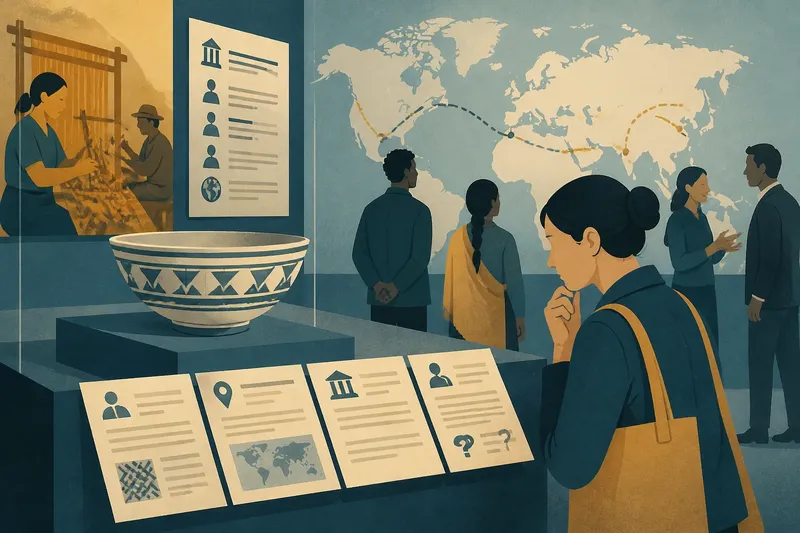
At an international museum exhibition, a bowl from one region may sit beside a map, a loan label, and a caption naming makers from somewhere else. A first visit to an international museum exhibition becomes more revealing when you read those details as parts of a relationship, not as proof that one display tells the whole story.
Start with what is actually in front of you: the object, its label, the exhibition’s arrangement, and the limits the museum acknowledges. You do not need specialist knowledge. A few deliberate questions can show how an exhibition describes exchange, shared histories, and the work of cooperation—while leaving room for what remains uncertain.
What should I notice before reading the labels?
Give the room a quick look before settling on any one object. Notice the exhibition title, its introductory panel, the order of rooms, and whether the display is organized by place, material, period, or theme. That structure is already an argument about what belongs together.
Look for the institutions named on the opening panel. A list of partner museums, lenders, communities, or cultural organizations can show who helped make the exhibition possible. Then check whether the exhibition describes those participants as active collaborators or mentions them only in a credit line.
Pay attention to the boundaries. Does the show include several places connected by a shared material or practice, or does it focus on one route, community, or collection? A focused exhibition can be thoughtful without being comprehensive. The useful question is not whether it contains everything, but whether it tells you what it has chosen to include.
It is not worth trying to photograph or read every panel in order. Choose a small number of objects that catch your attention, then follow their labels carefully. That leaves room to notice how the exhibition links them.
How can I tell what a borrowed object’s label means?
A loan label usually identifies the organization or person lending an object and may name the institution that holds it. Read the wording closely: “on loan from” tells you about the exhibition arrangement, not necessarily the object’s full history or the lender’s relationship to the community connected with it.
Look for several kinds of information, and keep them distinct:
- Maker or community: Who made, used, or cared for the object, if the exhibition identifies them?
- Place and context: Does the label name where it came from, where it was used, or where it is held now?
- Ownership or custody: Does it explain how the holding institution acquired it, or leave that history unstated?
- Loan and credit: Which museum, organization, or individual lent it, and who else contributed knowledge?
- Uncertainty: Does the label mark an attribution or date as uncertain rather than present it as settled?
These details answer different questions. A lender is not automatically the maker, the community of origin, or the only source of knowledge. If a label provides a collection history, read it as the museum’s account of that history. If it does not, note the gap rather than filling it in yourself.
Imagine you see a woven cloth labeled with a community name, a region, and a contemporary museum lender, but no account of how the museum acquired it. You can observe that the exhibition connects the cloth to that community and identifies its current lender. You cannot infer from those facts alone whether its transfer was voluntary, contested, or documented elsewhere.
What do captions reveal about connections between places?
Captions can connect an object to materials, makers, uses, routes, or later collections. Read the verbs as carefully as the nouns. “Made,” “traded,” “carried,” “collected,” “gifted,” and “seized” describe different relationships; a vague phrase such as “came from” may leave the nature of a transfer unclear.
Look for the scale of the claim. A caption might establish that a particular material was used in an object, or that a named person brought it to another place. It does not necessarily establish how common that practice was, who controlled the exchange, or what everyone involved thought about it. A single object can make a connection visible without representing every person or transaction in that connection.
Notice whose names appear. Are makers, translators, researchers, lenders, and community advisers credited? Are local names presented alongside familiar museum terms? Credits are not decorative; they can make the work behind an exhibition legible. Their absence, however, does not prove that no one contributed. It tells you only what the display makes visible.
Also watch for the difference between a place of origin and a place of later use. An object may have been made in one location, exchanged in another, and held in a collection elsewhere. When captions compress those stages into one label, ask which stage the wording is describing.
Who decides what belongs in the exhibition?
The exhibition’s selection and arrangement reflect curatorial choices. Curators decide which objects to request, how to group them, what context to provide, and where to place gaps or disagreements. Those choices shape the story visitors encounter, even when the objects themselves are authentic and carefully cared for.
Look for signs of collaboration. The exhibition may identify advisers, source-community representatives, partner institutions, translators, or conservation specialists. It may also explain that a lender set conditions for display or that some material is not shown. Such details help visitors see that making an exhibition can involve negotiation, expertise, and limits—not only selection by a museum.
Ask whether the display distinguishes among the people and institutions involved. A museum may hold an object while a community maintains cultural knowledge about it; a lender may arrange a loan while another group advises on interpretation. “The museum says” can conceal these differences. More precise credits and captions can show who contributed which knowledge or decision.
Where the exhibition does not explain its process, resist assuming either complete agreement or complete exclusion. You can describe what is present in the room and what the labels say about participation, then leave unaddressed matters open. That is a careful reading, not a failure to reach a verdict.
How should I read an exhibition that presents a shared history?
Check whether the exhibition describes connections as reciprocal, unequal, or changing. Shared history does not mean equal influence. A display about an exchange might show that people adopted, adapted, or transformed materials and ideas, while also acknowledging that power shaped who moved them, who benefited, and who recorded the story.
Look for more than one direction of influence. Does the exhibition show what traveled, who carried or made it, and how it changed in a new setting? Does it also explain what remained local or why some knowledge is absent? A map can help locate places, but lines between them do not by themselves explain the terms of a relationship.
Be alert to broad claims built from a narrow selection. An exhibition may use a few objects to introduce a larger topic, but a careful caption should make the relationship between those objects and the wider claim understandable. If you cannot tell whether a point applies to one object, one community, or a broad region, treat the scope as unclear rather than silently expanding it.
This is also where restraint helps. Avoid turning one display into a scorecard of which place contributed more, or into a simple story of influence flowing in a single direction. The objects may support a more layered account, but the labels should show how far that account reaches.
What questions help me understand a first museum visit?
Should I read every caption in order?
No. Read the introductory panel, then choose a few objects and compare their labels. If a connection interests you, follow the nearby captions that explain it.
What if a label gives very little context?
Separate what it states from what you would like to know. You can note the missing information and look for another panel, an exhibition guide, or a staff member who can clarify what the museum makes available.
Can I trust a map or timeline as the full story?
Treat each as a tool for locating events, not a complete account of relationships. A map may show movement without explaining who controlled it, while a timeline can make overlapping experiences look more neatly ordered than they were.
What should I do if the exhibition’s wording feels one-sided?
Identify the specific wording or omission that prompted the reaction, then check whether another caption or credit provides context. If the question remains, you can ask museum staff how visitors may share feedback without assuming that one brief label settles the issue.
How can I leave with a useful account of what I saw?
Before leaving, choose one object and write down three things: what the label states, what relationship it makes visible, and what remains unanswered. Keep the notes separate. That simple distinction helps prevent an observation from turning into an unsupported conclusion.
Say you have been drawn to a carved box displayed with a map and a caption describing its material and current lender, but not its acquisition history. Your note might say that the exhibition links the box to a named place and identifies who lent it; it might also record that the transfer history is not explained in the text you saw. The result is a clear account of the display without pretending to know what it leaves out.
You can also record the exhibition’s own limits: a stated focus, a missing category of objects, a short credit list, or a note that some material could not be shown. These are not automatic signs of failure. They are useful clues about the scope of the account and the cooperation required to present it.
A first visit to an international museum exhibition does not need to produce a final judgment about an object or a relationship. It can leave you with a more precise question: who made this connection visible, what evidence did the display offer, and whose knowledge would help complete the picture? That question is useful well beyond the museum door.